Today the design community has shifted its focus to more welcoming, comforting buildings designed for people’s daily lives. Natural materials like wood and stone, access to daylight, and connections to the outdoors are no longer considered “nice to have” — they are central to how spaces support comfort, well-being and productivity. This approach, often referred to as biophilic design, reflects a growing body of research showing that environments inspired by nature can reduce stress, improve focus and create places people genuinely want to be.
At the same time, safety remains the top priority for building professionals, owners and occupants alike. Fire performance, code compliance and long-term durability are non-negotiable — especially as wildfire risk and building regulations continue to evolve.
This is where fire-retardant-treated wood (FRTW) offers an advantageous solution. Code-compliant FRTW allows project teams to meet stringent fire requirements while preserving the visual warmth and architectural flexibility of wood. Rather than forcing a tradeoff between safety and aesthetics, FRTW makes it possible to achieve both.
Key Takeaways
- Safety and design aren’t tradeoffs. Code-compliant fire-retardant-treated wood (FRTW) lets architects meet fire performance requirements while preserving the natural look and inviting nature of exposed wood.
- FRTW is pressure-impregnated, not surface-coated. The treatment penetrates the wood itself, so grain, color and finish options stay intact — unlike a topical coating.
- It works across exposed, design-forward applications. Ceilings, feature walls, beams, columns and interior accents can all use code-compliant FRTW products like PyroGuard™ and ExteriorFireX™-treated Redwood.
- It’s already proven in the field. Architects and builders across the country are specifying FRTW on projects that pair fire performance with visual impact.
What Is Fire-Retardant-Treated Wood (FRTW)?
Fire-retardant-treated wood is lumber or plywood that has been pressure-impregnated with chemicals formulated to slow the spread of flames and reduce smoke development. Unlike surface coatings, the treatment penetrates the wood, so it keeps performing even as the material is cut, finished or exposed over the life of a building.
For design teams, that means FRTW can be specified anywhere code calls for improved fire performance — exposed ceilings, feature walls, structural beams — without giving up the look and feel of natural wood.
Fire-retardant-treated wood products that enhance design
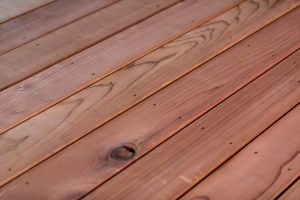
FRTW bridges the gap between performance and appearance. Products like PyroGuard and our newest offering, ExteriorFireX-treated Redwood, are meant to be seen, combining visual appeal with code-compliant fire protection.
Where Design-Forward FRTW is Used
Common design-forward uses include:
- Exposed ceilings and roof decks
- Wall panels and feature walls
- Beams, columns and structural elements
- Interior architectural accents
- Decks, balconies and pergolas
Fire-Retardant-Treated Wood in Design-Forward Construction
Across the country, architects and builders are using FRTW to create buildings that are both safe and visually compelling. From exposed wood ceilings in office environments to dramatic structural elements in public spaces, these projects demonstrate that fire performance does not have to come at the expense of beauty.
Building for the future doesn’t mean choosing between safety and design. With code-compliant fire-retardant-treated wood, project teams can affordably meet today’s fire requirements while creating spaces that feel comfortable, inviting, and built to last.
FAQs: Fire-Retardant-Treated Wood for Design Teams
Does FRTW change how wood looks or finishes?
No. FRTW is pressure-impregnated into the wood rather than applied as a surface coating, so it can still be stained, painted or left natural — grain, color and texture stay intact.
Is FRTW code-compliant for exposed structural use?
Yes, when it’s manufactured and tested to the applicable standards for the application — interior or exterior, load-bearing or non-load-bearing. Confirm the specific code section requirements for interior and exterior applications with the building department in the community where the project will be built.
Does fire-retardant treatment affect the wood’s structural strength?
Properly manufactured FRTW is designed to maintain the structural properties of the base wood species. Refer to manufacturer technical data for span and load specifications.
Can FRTW be used both indoors and outdoors?
Interior and exterior FRTW use different chemical formulations, since exterior products must withstand repeated wetting and drying cycles. Confirm which type is specified for interior vs. exterior applications.
Building for the future doesn’t mean choosing between safety and design. With code-compliant fire-retardant-treated wood, project teams can meet today’s fire requirements while creating spaces that feel comfortable, inviting and built to last.