Designing Safe Public Spaces: The Role of Fire-Retardant-Treated Wood in Schools, Hospitals and Retail Environments
Fire-retardant-treated wood (FRTW) is playing an increasingly important role across a wide range of building applications. Once associated primarily with large industrial projects, FRTW is now commonly used to meet the building code in commercial buildings, schools, hospitals and retail centers.
Key Takeaways
- Wood-frame construction can cut costs significantly. In Hoover’s own analysis of a 73,557-square-foot elementary school, an all-wood frame cost approximately 40% less than an all-steel frame.
- FRTW meets strict fire code across very different building types. The same material performs in school classrooms, hospital construction and retail spaces with some of the toughest fire requirements.
- Hospitals get a cost and comfort benefit beyond fire performance. Wood construction avoids the metal-shielding costs required around sensitive equipment like MRI machines, and natural materials are linked to better patient well-being.
- Third-party certification matters most for high-profile projects. Hoover’s UL certification supports credibility on government, large-retail and global institutional work.
Fire-Retardant-Treated Wood in Schools: Safety on a Budget
According to the National Fire Protection Association (NFPA), U.S. fire departments responded to an average of 3,230 fires per year in K–12 schools from 2014 to 2018. Factors such as overloaded electrical systems, paper-heavy classroom décor, science labs and cafeterias all contribute to a school’s fire risk. At the same time, schools must balance safety concerns with tight budgets and strict compliance requirements.
In a study conducted by Hoover’s Director of Fire and Life Safety Codes, Dr. Dave Bueche, construction costs were compared for a one-story, 73,557-square-foot elementary school built with an all-steel frame versus a frame where the wood is all FRTW. The analysis found that construction utilizing fire-retardant-treated wood reduced building costs by approximately 40 percent compared to using steel and other materials.
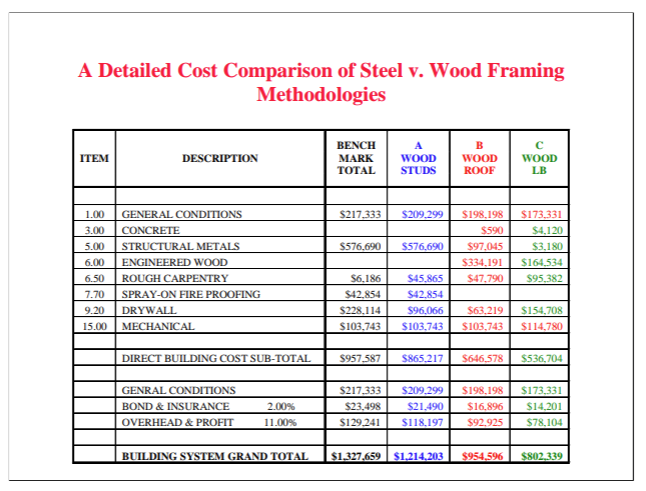
Building schools with FRTW can achieve significant cost savings without compromising fire performance.
Fire-Retardant-Treated Wood in Hospitals: Lower Costs, Better Patient Environments
Hospitals are among a community’s most critical facilities, and they must remain operational during emergencies. Beyond fire scenarios, however, FRTW offers meaningful advantages throughout both construction and the building’s life cycle.
Hospitals house sensitive and expensive equipment (such as MRI machines) that can be affected by metal. When facilities are built with concrete and steel, those materials often require additional shielding, increasing project costs. Wood construction eliminates the need for these protective measures, helping reduce upfront expenses.
Equally important, hospitals are designed to support healing. Research shows that incorporating natural elements, such as wood, can create warmer, more inviting environments that positively influence patient well-being.
By using FRTW, hospitals can lower material costs and enhance the patient experience without compromising fire safety or code compliance.
Fire-Retardant-Treated Wood in Retail: Meeting Code Without Sacrificing Design
Retail projects come with some of the strictest fire performance requirements, all of which FRTW can meet. What truly sets retail construction apart is the variety of uses under one roof — from mercantile spaces to kiosks and even playgrounds. These typically require noncombustible materials or added fire protection, both of which can be achieved using FRTW.
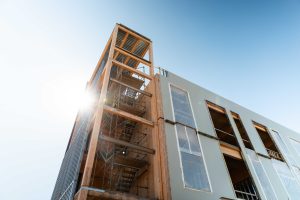
Retail buildings are also highly visible community spaces, and how they look matters. Exterior and exposed FRTW can be used as an architectural feature, adding warmth and character that’s difficult to achieve with concrete and steel alone.
Why choose FRTW for your next project?
FRTW enhances building safety while balancing other critical project needs, including:
- Regulatory compliance: Many jurisdictions require FRTW in specific applications, such as in multifamily residential buildings, commercial structures and schools. Using FRTW helps ensure compliance with these regulations, reducing the risk of fires and enhancing overall safety.
- Affordability: FRTW is usually less expensive than other noncombustible materials like concrete and steel.
- Aesthetics: Wood provides natural warmth and character without sacrificing fire performance.
- Third-party certification: Third-party certifications, such as our UL certification, positions Hoover as a trusted partner for high-profile projects such as government contracts, large retailers and global clients as they often require third-party certification.
To learn more about building safer public spaces with fire-retardant-treated wood, visit frtw.com.
Sources
- Fire-Retardant-Treated Wood: An American Innovation
- Fire Retardant Wood Products Astm E2768 Test Results Summary
- Selling FRTW
- Fire Retardant Treated Wood in Educational Buildings
- Leading The Way With UL Certification And A Commitment To Safety
- NFPA: Structure Fires in Schools
- How biophilic design promotes healing in healthcare environments