Across the country, communities are facing a shared challenge: how to build more housing while managing growing safety risks. Bipartisan efforts at the federal, state and local levels continue to push for increased housing production to ease supply shortages. As a result, development is expanding beyond traditional urban cores and into areas where neighborhoods meet natural landscapes — known as the Wildland-Urban Interface, or WUI.
The WUI is any area where structures and other human development meets or intermingles with wildland vegetative fuels.
Population growth in these regions has increased significantly, particularly in the Western United States. A recent USA TODAY analysis found that roughly 1 in 20 Americans live in areas facing “high” or “very high” wildfire risk.
As housing continues to move to higher risk areas, building practices must evolve to protect life safety.
Protecting buildings in the WUI
There are two proven strategies for protecting buildings in the WUI: making structures more ignition-resistant and reducing surrounding wildland fuels. When used together, these approaches significantly improve a building’s ability to withstand a wildfire. At Hoover Treated Wood Products, we focus on hardening the structure itself.
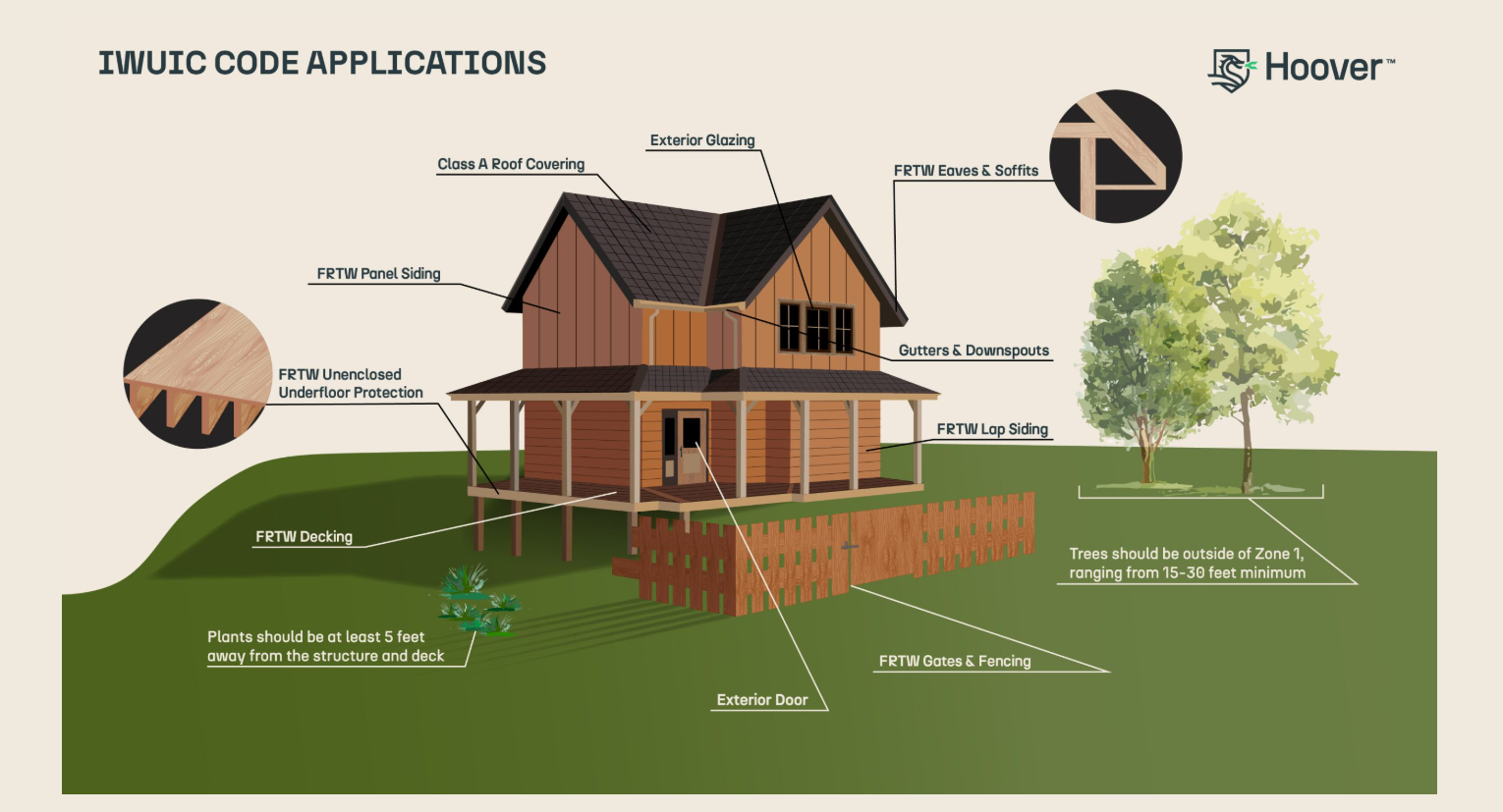
One of the most effective ignition-resistant building materials for hardening the structure is fire-retardant-treated wood (FRTW). FRTW is real wood that has been pressure impregnated with specially formulated fire-retardant chemicals. This treatment combines the fire-retardant chemicals into the wood, and protects buildings by:
- Reducing the chance of ignition when embers land on vulnerable surfaces such as siding, eaves or decks
- Slowing flame spread, helping prevent a small ignition from becoming a larger fire
- Maintaining structural strength longer during a fire, giving occupants more time to evacuate and firefighters more time to respond
Why choosing the right product matters
Not all treated wood provides the same level of protection. The International Building Code defines fire-retardant-treated wood as “any wood product that, when pressure treated during manufacture and tested in accordance with ASTM E84 or UL 723, achieves a flame spread index of 25 or less. The test is extended an additional 20 minutes to confirm the flame front does not progress more than 10.5 feet beyond the burner centerline.”
Simply, this means code-compliant FRTW is proven to resist ignition and limit flame spread under severe fire exposure. Products that are not pressure treated, properly tested or clearly labeled (see labeling requirements below) may look similar but cannot be relied on to deliver the same level of protection in real wildfire conditions.
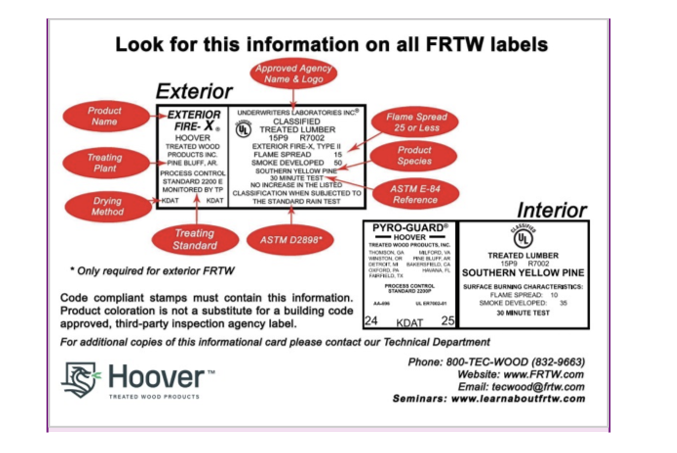
FRTW used in WUI settings must satisfy stringent performance criteria, including:
-
-
Reaction to fire test (ASTM E84 / UL 723): Extended 30-minute test (versus typical 10-minute tests) for flame spread to ensure long-duration resistance.
-
Accelerated weathering (ASTM D2898): Materials must be subjected to simulated weathering (e.g., repeated cycles of wetting and drying) before fire testing, to replicate real-world outdoor exposure.
-
Moisture content: After treatment, the fire-retardant-treated wood must be kiln- dried (KDAT) to ensure moisture stability, per code (e.g., IBC requires 15% MC for FRT plywood and 19% MC for FRT lumber).
-
Third-party quality certification: Products must be certified (tested, listed, and labeled) by an independent third-party agency (e.g., UL Solutions) to verify compliance with code requirements and referenced performance standards.
-
Take action
If you are building in a wildfire-prone area, material selection matters. Understanding local WUI designations, staying current on building code requirements and choosing code-compliant materials can make a meaningful difference in long-term safety and resilience.
At Hoover, we are committed to protecting people where they live, work, learn and play through trusted, code-compliant fire-retardant-treated wood. To learn more about WUI construction and best practices, explore resources from our experts:
FireWise Construction: Site Design & Building Materials
FRTW Design & Construction Guide