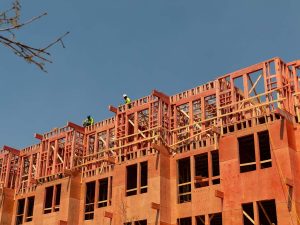
Building and fire safety codes continue to evolve across commercial, multifamily, and residential construction. Fire-Retardant–Treated Wood (FRTW) plays a major role in meeting code and improving building performance. Understanding what FRTW is, how it works, and when it is required helps builders, architects, and code officials choose the right solution for each project.
What Is Fire-Retardant Treated Wood (FRTW)?
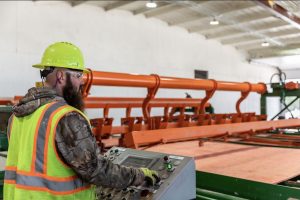
Fire-Retardant-Treated Wood is lumber or plywood that has been pressure impregnated with chemicals specially formulated to slow the spread of flames and reduce smoke development. At Hoover Treated Wood Products, our FRTW products complete a proprietary pressure-treatment process that enhances the natural properties of wood.
- PyroGuard™: An interior-use FRTW lumber and plywood for enclosed structural applications.
- Exterior FireX™: Exterior-use FRTW, such as redwood or Western red cedar, that is designed for high-moisture environments.
What Are the Benefits of FRTW?
Fire-Retardant-Treated Wood offers several performance and code compliance advantages that make it a valuable choice for architects, builders, and developers, including:
- Improved flame spread and smoke performance ratings.
- Compliance with major building codes for applications requiring increased fire performance.
- Reduced contribution to fire growth in the early stages.
- Minimal corrosion characteristics when used with standard fasteners.
- Lighter weight compared to noncombustible alternatives such as steel.
- Easy to cut and handle using conventional tools.
- Contributes to safer evacuation times and improved fire suppression effectiveness.
What Is the Difference Between Fire-Retardant-Treated Wood and Preservative-Treated Wood?
Preservative-treated lumber protects against biological hazards, while FRTW protects specifically against fire. As they are made to serve very distinct purposes, they cannot be substituted for one another. Understanding this helps ensure the right material is chosen for the intended application.
Fire-Retardant-Treated Wood (FRTW)
- Treated with fire-retardant chemicals.
- Designed to slow the spread of flames and reduce smoke production.
- Common in wall assemblies, roofs, partitions, and concealed spaces.
- Used when building codes require improved fire performance.
Preservative-Treated Wood
- Treated with preservatives for resistance to decay, rot, and insects.
- Not formulated for fire safety.
- Common in outdoor decks, landscaping, and ground-contact applications.
How Can You Tell if Wood Is Fire-Treated?
You can identify FRTW through several indicators:
- Certification stamps or labels on each piece of FRTW lumber or FRTW plywood.
- Manufacturer name and product designation.
- Testing standard references, such as the ASTM E-84 (UL 723) 30-minute flame-speed test.
- Third-party inspection agency marks.
- Job site documentation, such as treatment certificates.
All Hoover FRTW products are third-party inspected and clearly stamped to ensure compliance with building code requirements and industry standards.
When Is Fire-Retardant-Treated Wood Required?
Building codes recognize that FRTW can be used in leu of noncombustible materials in areas requiring increased fire performance.
Common applications include:
- Exterior and interior wall assemblies in Type I, II, and III construction.
- Multifamily and commercial roof decks.
- Eaves, soffits, and fascia in certain fire zones.
- Partitions and fire-rated assemblies in concealed areas.
- Fire-resistance-rated assemblies that are allowed by the International Building Code (IBC).
- Structures in jurisdictions with wildland urban interface requirements.
When in doubt, always verify compliance with the local building code, Authority Having Jurisdiction (AHJ) requirements, and project specifications.
What Chemicals Are Used to Treat Fire-Retardant Wood?
FRTW is treated using formulations that promote char formation and reduced flame spread.
Treatment chemicals typically include:
- Phosphates
- Borates
- Other proprietary fire-retardant salts that are designed for long-term performance.
Hoover’s PyroGuard™ and Exterior FireX™ products use proven, code-compliant formulations that remain stable during service life and maintain the structural performance of the wood. Each product undergoes independent testing and third-party quality control for reliability.
What Are the Applications for FRTW Products?
FRTW lumber and FRTW plywood can be used in many fire-rated or fire-resistive building assemblies.
Typical applications include:
Interior Applications (PyroGuard™)
- Roof Sheathing.
- Framing Lumber.
- Interior Walls and Partitions.
- Attic and Concealed Spaces.
Exterior Applications (Exterior FireX™)
- Exterior Walls and Trim.
- Soffits and Fascia.
- Open-Air Pavilions.
- Exterior Roof Decking.
- Any Area Permanently Exposed to Weather or High Humidity.
Selecting the right FRTW product ensures long-term durability and code compliance.
What Are the Advantages of PyroGuard™ and Exterior FireX™?
PyroGuard ™ and Exterior FireX™ offer distinct performance advantages that help meet building and fire safety requirements while supporting the unique needs of interior and exterior construction applications.
PyroGuard™ Advantages
- Enhanced fire performance backed by comprehensive testing.
- Classified by Underwriters Laboratories for 2-hour load-bearing assemblies.
- Low smoke development helps improve visibility during a fire.
Exterior FireX™ Advantages
- Weather-resistant durability for exterior installations.
- No significant degradation after repeated wet-dry cycles.
- Maintains performance without the need for additional surface treatments.
- Code compliant for exterior structural applications.
Why Choose Hoover FRTW Products?
As a leader in Fire-Retardant Treated Wood, Hoover provides products that combine safety, durability, and code compliance. Our interior and exterior FRTW products are backed by decades of testing, real-world performance, and third-party verification.
Whether you need FRTW wood for structural assemblies, interior partitions, or weather exposed areas our PyroGuard™ and Exterior FireX™ products provide trusted protection.
Get Guidance on Your FRTW Project
If you have questions about our FRTW products, building code requirements, or selecting the right FRTW lumber or FRTW plywood for your project, our team is ready to help.
Contact the Hoover team today to speak with an expert and get the support you need.